


Reliable Partner Co. Ltd. 惠譽拍檔有限公司 | Corporate Gift Customisation Guide
Custom Insulated Bottle Guide: Stainless Steel vs Tritan™ and Customisation Tips
When customising insulated cups or water bottles for a company, look beyond appearance, capacity and logo design. Compare the material, insulation construction, weight and intended use as well. A vacuum-insulated stainless-steel bottle and a Tritan™ bottle serve different purposes, while ECOZEN® is another transparent copolyester material. This guide compares the three material directions, explains use and cleaning considerations, and outlines the custom-gift process so businesses can plan drinkware around the occasion, audience and budget. Always check the selected finished product’s label and documentation for heat, food-contact and cleaning conditions.
Tritan™ Material: Introduction and Key Characteristics
What Is Tritan™? Check the Material and Food-Contact Information
Tritan™ is a copolyester material from Eastman and is used in water bottles and other everyday products. Eastman states that Tritan™ does not contain BPA, BPS or other bisphenol compounds, and describes its clarity, durability and impact resistance. These are the material supplier’s statements about Tritan™. When selecting a bottle, also check the specific resin grade, finished-product use and relevant food-contact documentation. U.S. FDA food-contact regulation applies to substances, specified uses and applicable limitations; it should not be paraphrased as blanket FDA “approval” of every finished water bottle. Eastman Tritan™ FAQs | FDA guidance on food-contact substances
Tritan™ Applications and Product Selection
Tritan™ has a transparent appearance, and Eastman also describes it as durable and shatter resistant. For a corporate gift, consider whether the bottle’s shape, capacity, lid and intended setting suit an event or membership gift. Tritan™ itself is not an insulation structure. If heat or cold retention is required, check whether the finished product has a vacuum-insulated layer and review the specifications for that model.
Tritan™: Advantages and Use Considerations
Tritan™ Product Characteristics to Consider
Eastman’s general product information describes the characteristics below. Actual performance still depends on the resin grade, bottle design and how the product is used:
- Transparent appearance: Makes it easier to see the water level and the bottle’s cleanliness.
- Impact and shatter resistance: Eastman describes Tritan™ products as impact and shatter resistant; this does not mean every finished product is immune to damage in all drop situations.
- Cleaning, staining and odour: Eastman mentions stain and odour resistance in some food-storage applications. Follow the cleaning instructions for the actual drinkware product.
- Material composition information: Eastman states that Tritan™ does not contain BPA, BPS or other bisphenol compounds. If a procurement specification has a particular requirement, request documentation for the relevant grade and finished product.
A plastic surface may be scratched by repeated cleaning with the abrasive side of a scouring pad, a metal brush or an abrasive cleaner. Tritan™ material is not, by itself, a vacuum-insulated cup; heat or cold retention depends on the finished product’s insulation construction and model.
Tritan™ Heat Resistance and Everyday Use
Heat-use conditions vary by Tritan™ grade and finished product. A resin’s laboratory heat-performance data is not the same as a water bottle’s recommended liquid temperature, and does not replace instructions for the bottle body, lid, seal and printed decoration as a complete product. Check the product label or supplier documentation before use. Do not assume that a bottle can hold boiling water, go in a dishwasher or be sterilised at high temperature unless the finished product is expressly marked as suitable. Some Eastman instructions for Tritan Renew apply only to that specific material and should not automatically be applied to every Tritan™ resin or finished product.
For cleaning a Tritan™ bottle, follow the finished product’s instructions. A soft sponge or bottle brush and mild washing-up liquid may be used where appropriate; avoid wire brushes and abrasive cleaners. Use a dishwasher only if the product instructions expressly allow it. After washing, the bottle body, lid and sealing ring can be separated to air-dry if the product design permits, helping prevent moisture from accumulating.
ECOZEN® vs Tritan™: What to Compare When Choosing a Material
ECOZEN® Positioning and Grade Differences
ECOZEN® is SK Chemicals’ range of biomass-based transparent copolyesters. SK Chemicals lists several grades with different heat-resistance characteristics and applications including sports drink bottles, food containers and home appliances. In an announcement published in 2025, SK Chemicals said the ECOZEN® range can contain up to 15% biomass by carbon content. This is an “up to” figure for the range; it does not mean that every grade or finished product contains the same proportion, or that 15% of the whole bottle by weight is biomass. SK Chemicals ECOZEN® product page | SK Chemicals announcement from 2025
| Comparison | Tritan™ | ECOZEN® |
|---|---|---|
| Material positioning | Eastman copolyester; the supplier describes it as transparent, durable and impact resistant. | SK Chemicals’ range of biomass-based transparent copolyesters. |
| Heat performance | Depends on the grade and finished product; check the relevant resin and bottle information. | Multiple heat-resistance grades are available; confirm against the selected grade’s technical data and finished-product label. |
| Impact resistance and durability | Eastman describes Tritan™ products as impact and shatter resistant. | Do not rank it against another material based on the name alone; compare tests and data for the specific finished products. |
| Chemical and stain resistance | Eastman mentions chemical resistance in its brand information and stain/odour resistance in some applications. | SK Chemicals lists chemical resistance; no direct comparison under the same test conditions was found. |
| Biomass-based content | Distinguish standard Tritan™ from other specific versions; confirm the selected product. | SK Chemicals says the ECOZEN® range can contain up to 15% biomass by carbon content; confirm the proportion for the selected grade. |
| Food-contact and use conditions | Check documentation for the specified grade and complete bottle. | Check documentation for the specified grade and complete bottle. |
Information for the two materials may refer to different test methods and grades. Without comparative tests under the same conditions, it is not appropriate to claim that one is necessarily more heat resistant, stain resistant or durable. If a company needs particular food-contact documents, test data or environmental certification, specify the requirement before quotation and verify it against the selected finished product.
Factors for Choosing Bottle Materials for Corporate Gifts
First decide whether the drinkware will mainly hold cold or hot drinks and whether it will often be carried outdoors. Then compare capacity, leak-resistant design, lid, handle, decoration method, budget and minimum order quantity. Procurement teams can also request the relevant food-contact documents and use instructions. If biomass-based content is part of an ESG message, verify the selected grade and finished-product information. A material name or the maximum percentage stated for a range does not prove that the finished product has a particular environmental certification or overall environmental benefit.
Custom Insulated Bottle Guide: Stainless Steel or Tritan™?
Why Do Companies Consider Custom Insulated Bottles?
Drinkware can be customised around a brand design and event, and may be used at work, in meetings, on business trips or when travelling. If the recipient continues to use it, the logo may appear in everyday settings. Actual usage frequency and exposure vary from person to person and cannot be guaranteed.
Bottle colour, capacity, lid, handle, logo, tagline and packaging can all be considered during design. Available options, print position and decoration method must be confirmed for the selected bottle, material and order quantity. Client appreciation, employee benefits, anniversaries and VIP gifts may each call for a different design direction.
Tritan™ Bottles vs Stainless-Steel Insulated Bottles
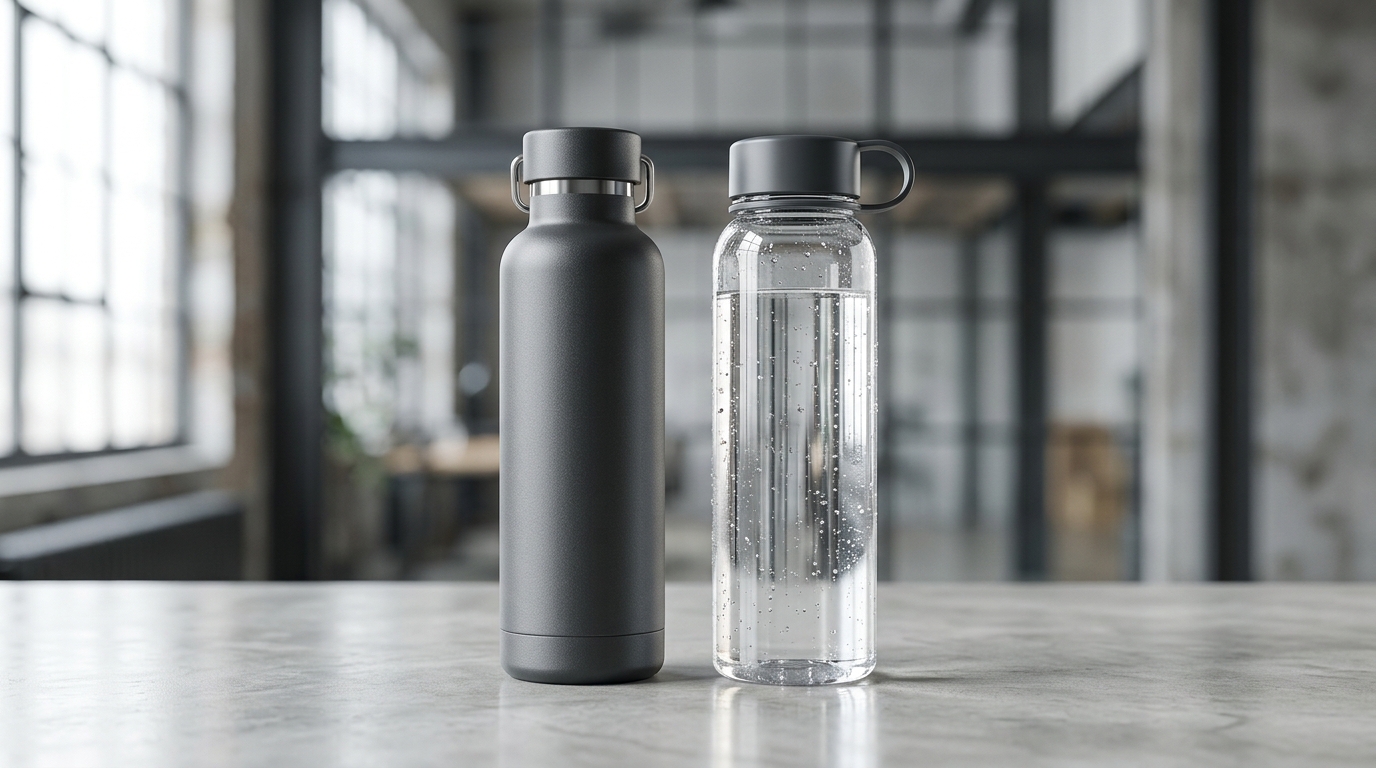
The comparison below uses a vacuum-insulated stainless-steel drink bottle and a typical Tritan™ bottle as selection directions. Heat or cold retention, weight and use still depend on the individual model; stainless steel alone does not provide vacuum insulation.
| Comparison | Vacuum-insulated stainless-steel bottle | Tritan™ bottle |
|---|---|---|
| Main characteristics | A vacuum-insulated design may be intended for heat or cold retention; check the model’s performance data or label. | Transparent appearance; Eastman describes Tritan™ products as impact and shatter resistant. |
| Appearance direction | Metallic finishes, lids and surface treatments can create different gift styles. | A clear appearance, with colours or patterns depending on the bottle design. |
| Possible use settings | Business gift sets, employee gifts or client gifts, subject to budget and model selection. | Event, sports or everyday carry drinkware, depending on the audience and model. |
| Customisation | Some surfaces may suit laser engraving or pad printing; confirm compatibility with the bottle surface and artwork. | Logo, artwork and colour design can be explored for the finished surface; confirm the method for each model. |
| Weight and portability | Weight depends on capacity, steel thickness and insulation construction. | Many designs are positioned as portable; actual weight depends on capacity and construction. |
Six Steps for Custom Insulated Bottle Production
Plan a corporate gift by confirming its purpose, audience, bottle, design and packaging:
- Confirm purpose and audience: Decide whether the gift is for client appreciation, employee benefits, VIP gifting or event distribution.
- Set the budget and quantity: Compare materials, capacity, packaging and order quantities against the total budget.
- Select a bottle: Compare stainless-steel construction, lid, capacity and insulation information, or the specifications of a Tritan™ bottle.
- Add the brand design: Prepare artwork using the logo, brand colours, event theme or anniversary elements.
- Approve the sample and production plan: Check the logo position, colour, size and actual appearance before confirming bulk production.
- Arrange packaging and delivery: Confirm gift boxes, cards or other brand elements and the delivery arrangements required for the event.
Common Printing Methods and Custom Options
For custom drinkware, consider decoration options in relation to the material and finished surface:
- Laser engraving or pad printing: May be considered for some stainless-steel bottle models; confirm surface, artwork and process compatibility first.
- Brand colours: Explore how bottle colour and packaging can work together, then confirm actual colour options and print results.
- Gift-box packaging: Consider a brand card, event message or anniversary element; packaging choices depend on the product and order.
Companies can also select capacity, lid, straw, handle or portability features according to the intended use. Planning the bottle, packaging and brand message together can support a consistent visual direction; feasibility should be checked for the selected model and sample.
Five Use Settings for Custom Corporate Bottles
Drinkware can be designed for different occasions. The following are planning ideas, not guaranteed campaign outcomes:
- VIP client appreciation: Select a bottle to suit the budget and occasion, including year-end or festive gifting.
- Employee onboarding and benefits: Include a bottle in a welcome kit or employee gift set; recipients’ experiences and perceptions will vary.
- Exhibition keepsakes: Use a gift as part of an event or brand-engagement plan. If collecting contact details, plan this separately and comply with applicable privacy requirements.
- ESG-themed promotion: Reusable drinkware may be one option for an event. Whether it reduces the use of disposable bottles depends on product choice and recipients’ later use; distribution alone cannot guarantee an environmental result.
- Brand collaboration: Explore a themed design subject to the relevant brand guidelines and authorisations. Obtain any required licence before using intellectual property or another party’s trademark.
If drinkware continues to be used, its logo may appear in the recipient’s everyday settings. Actual use and brand-exposure outcomes are not guaranteed, so product purpose, quality and audience needs should guide the design.
Frequently Asked Questions (FAQ)
Can a Tritan™ bottle hold hot water?
It depends on the selected grade and the complete bottle’s instructions. Do not assume that a bottle can hold hot water based only on the Tritan™ material name. If the product does not clearly say that it can hold boiling water, do not pour boiling water into it. The lid, sealing ring and printed decoration must also be suitable for the intended conditions.
Can a Tritan™ bottle be heated in a microwave?
Only use it in a microwave if the complete finished product is clearly labelled as microwave-safe, and follow its instructions. The lid, sealing ring and printed decoration may not be suitable. Eastman’s specific guidance on Tritan Renew does not mean that every Tritan™ bottle or accessory is microwave-safe.
Which is more suitable as a corporate gift, Tritan™ or ECOZEN®?
If transparent appearance and Eastman’s stated characteristics for Tritan™ matter, compare the relevant Tritan™ bottles. If biomass-based material is part of the selection criteria, review SK Chemicals’ information for the ECOZEN® grade. Heat resistance, impact performance and food-contact conditions cannot be determined from the brand name alone. Choose according to the campaign theme, budget, product design, finished-product specifications and required documents, and verify the selected model.
Customise Practical Drinkware and Corporate Gifts
Contact Reliable HK 惠譽拍檔 for Product Selection and Quotations
Reliable Partner Co. Ltd.(惠譽拍檔有限公司)was established in 2004. Its official profile lists more than 1,000 promotional-gift options and describes its event management, advertising production and design and development services. The team can help plan around product direction, brand design, packaging and procurement requirements. Actual materials, food-contact documents, decoration methods, minimum order quantities and lead times must be confirmed for the selected product and order.
Planning a promotion or employee-benefit programme? Browse the Reliable HK gift categories, explore ESG tableware and drinkware options, or use the contact page or WhatsApp enquiry to discuss styles, decoration, order quantities and quotations.
Material References
This material overview refers to Eastman Tritan™ FAQs, the Eastman Tritan™ brand page, the SK Chemicals ECOZEN® product page, an SK Chemicals announcement from 2025 and U.S. FDA guidance on food-contact substances. Refer to the selected finished product’s label and documents for actual use conditions.
 Premium Gift Categories


